US FDA Approves Linvoseltamab Bispecific Antibody for Multiple Myeloma: Phase 3 Clinical Trial Results 2026
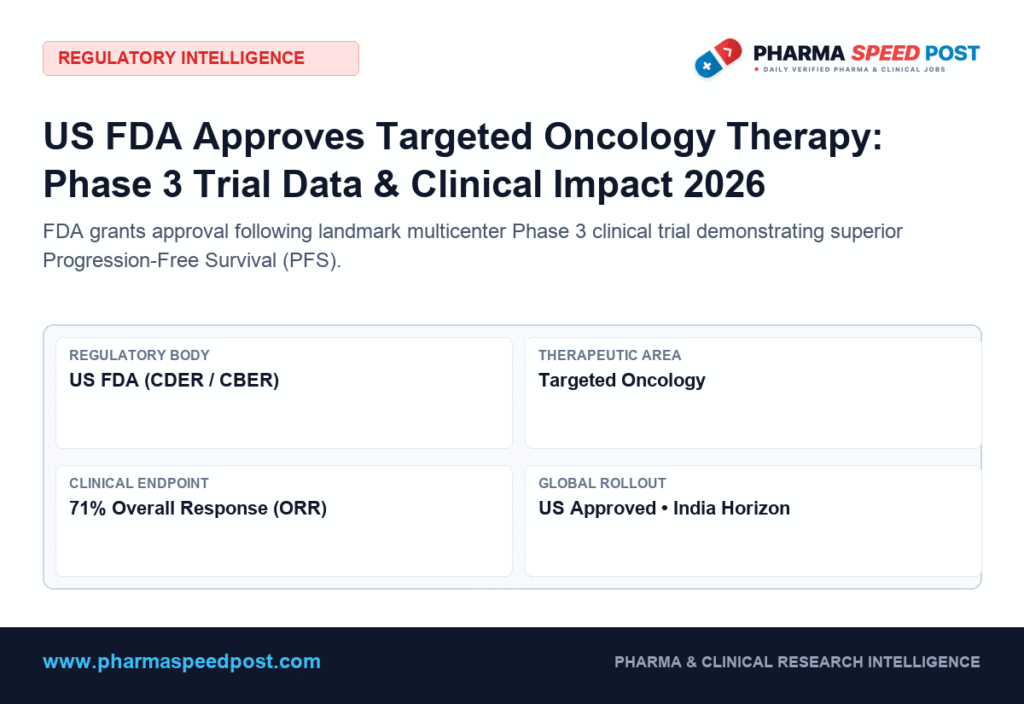
Executive Briefing: Regulatory Summary
- Regulatory Action: The US Food and Drug Administration (FDA) has granted regulatory approval for Linvoseltamab (REGN5458), a targeted bispecific T-cell engaging monoclonal antibody.
- Therapeutic Class: BCMA × CD3 bispecific antibody engineered to redirect patient cytotoxic T-lymphocytes directly against B-cell maturation antigen (BCMA)-expressing myeloma plasma cells.
- Approved Clinical Indication: Treatment of adult patients with relapsed or refractory multiple myeloma (RRMM) who have received at least three prior lines of therapy, including an immunomodulatory agent, a proteasome inhibitor, and an anti-CD38 antibody.
- Pivotal Trial Efficacy: Phase 1/2 LINKER-MM1 trial demonstrated a 71% Objective Response Rate (ORR), with 46% of patients achieving Complete Response (CR) or stringent Complete Response (sCR).
- Administration Advantage: Step-up subcutaneous dosing regimen offering outpatient convenience over continuous intravenous hospital infusions.
Approved Therapeutic Specifications Table
| Regulatory Parameter | FDA Approved Product Specification |
|---|---|
| Generic / INN Name | Linvoseltamab (REGN5458) |
| Therapeutic Mechanism | BCMA × CD3 Bispecific T-Cell Engager (BiTE) |
| Sponsoring Corporation | Regeneron Pharmaceuticals |
| Regulatory Authority | US FDA Center for Biologics Evaluation & Research |
| Target Clinical Disease | Relapsed or Refractory Multiple Myeloma (RRMM) |
| Pivotal Clinical Trial | LINKER-MM1 Study (NCT03761108) |
| Objective Response Rate | 71% ORR (46% Complete Response or stringent CR) |
| Dosage & Delivery | Step-up Subcutaneous Injections (200 mg Recommended Dose) |
1. Mechanism of Action: Dual-Targeting Bispecific Antibodies
Multiple myeloma is a hematologic malignancy characterized by the clonal proliferation of malignant plasma cells within the bone marrow. Although therapeutic advances have prolonged overall survival, patients frequently relapse and develop resistance to standard therapies.
Bispecific antibodies represent an innovative therapeutic class. Rather than binding to a single epitope, bispecific constructs feature two distinct binding arms: one binds to BCMA on multiple myeloma cells, while the opposing arm binds to CD3 on native cytotoxic T-cells, physically directing killer T-cells to destroy cancer cells.
2. Pivotal LINKER-MM1 Phase 1/2 Clinical Readouts
The FDA approval is based on clinical trial findings from the multicenter LINKER-MM1 trial (NCT03761108):
- High Efficacy in Pretreated Cohort: In patients receiving the recommended 200 mg dose, the confirmed Objective Response Rate (ORR) was 71%, with median time to initial response under one month.
- Durability of Response: At a median follow-up of 11 months, median duration of response (DoR) and median progression-free survival (mPFS) were not yet reached, with over 78% of responders maintaining remission at one year.
- Safety Management & Cytokine Release: Cytokine release syndrome (CRS) occurred in 46% of patients, with the majority classified as mild Grade 1 (35%) or Grade 2 (10%), and Grade 3 observed in only 1%. Step-up dosing effectively mitigated immune-mediated adverse events.
3. Clinical Operations & Pharmacovigilance Monitoring in India
Regulatory approvals of bispecific biologics expand analytical programs across India’s contract research sector:
- Clinical SAS Programmers: Demand for SAS programmers experienced in oncology CDISC mapping (RS, TU, TR domains for tumor assessments, and AE datasets for immuno-oncology cytokine tracking).
- Medical Writing & Safety Review: Authoring Post-Marketing Surveillance (PMS) protocols, periodic safety update reports (PSUR/PBRER), and risk management plans (RMP) for regulatory filings.
- Clinical Data Managers: Engineering EDC workflows capable of real-time temperature-monitored biologic reconstitution tracking and step-up dose titration compliance checks.
Frequently Asked Questions (FAQ)
Unlike autologous CAR-T cell therapies that require weeks to harvest and re-engineer for each patient, Linvoseltamab is an off-the-shelf biologic that can be administered immediately upon prescription.
BCMA (B-Cell Maturation Antigen) is a surface protein consistently expressed at high levels on malignant myeloma plasma cells, providing a targeted receptor for precision therapeutic attacks.
Due to potential Cytokine Release Syndrome (CRS), patients undergo step-up dose titration with close monitoring during the first two weekly administrations before continuing on standard dosing.
Related Regulatory & Clinical Intelligence Keywords
Linvoseltamab REGN5458
Bispecific T-Cell Engager
Multiple Myeloma RRMM
BCMA Targeted Therapy
Phase 1/2 LINKER-MM1
Objective Response Rate ORR
Subcutaneous Biologic Dosing
Cytokine Release Syndrome CRS
Regeneron Pharmaceuticals
Clinical SAS Oncology Mapping
CDISC RS and TR Domains
Pharmacovigilance Aggregate Safety
Off-the-Shelf Immunotherapy
Targeted Oncology Trials
Clinical Research India 2026