CDSCO Approves Phase 3 Trials for Indigenous CAR-T Cell Therapy in India: Clinical Endpoints & Safety 2026
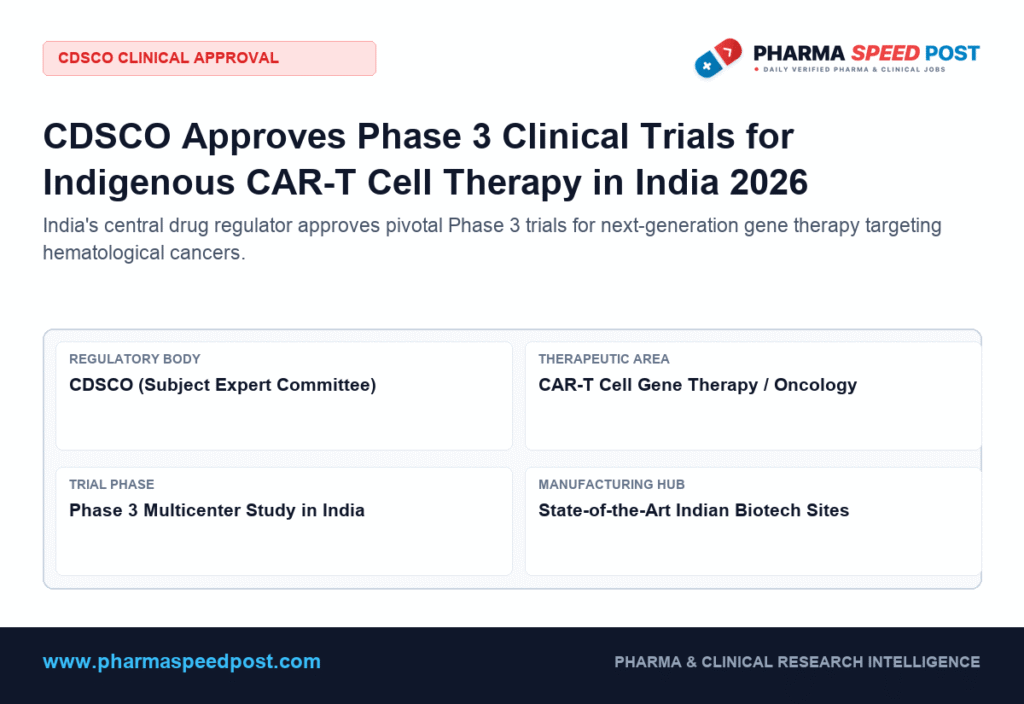
Executive Briefing: Regulatory Summary
- Regulatory Action: The Central Drugs Standard Control Organisation (CDSCO) Subject Expert Committee (SEC – Oncology & Hematology) has approved Phase 3 Multicenter Clinical Trials for India’s indigenous CAR-T cell therapy.
- Pioneering Asset: Humanized Chimeric Antigen Receptor (CAR) T-cell construct targeting CD19 antigens, developed by ImmunoACT in partnership with IIT Bombay and Tata Memorial Hospital.
- Target Indications: Relapsed and refractory B-cell Acute Lymphoblastic Leukemia (B-ALL) and Diffuse Large B-Cell Lymphoma (DLBCL) in adult and pediatric patient populations.
- Clinical Trial Scale: Phase 3 multicenter trial across premier institutions: Tata Memorial Hospital (Mumbai), AIIMS (New Delhi), CMC (Vellore), and ACTREC (Navi Mumbai).
- Affordability Impact: Delivers advanced gene and cell therapies at approximately 90% lower cost than imported alternatives, reinforcing India’s domestic biomanufacturing capabilities.
Clinical & Regulatory Specifications Table
| Regulatory Parameter | Official CDSCO Specification |
|---|---|
| Investigational Therapy | Humanized Anti-CD19 CAR-T Cell Construct |
| Therapeutic Class | Autologous Genetically Modified T-Cell Gene Therapy |
| Co-Developing Entities | ImmunoACT, IIT Bombay & Tata Memorial Hospital |
| Regulatory Authority | CDSCO (DCGI), Ministry of Health & Family Welfare |
| Committee Approval | Subject Expert Committee (SEC – Oncology / Hematology) |
| Trial Phase Approved | Phase 3 Multicenter Pivotal Registration Trial |
| Primary Endpoints | Overall Response Rate (ORR) & Complete Remission (CR) |
| Key Safety Endpoints | Cytokine Release Syndrome (CRS) & ICANS Neurotoxicity |
1. Strategic Significance for Indian Cellular Immunotherapy
Chimeric Antigen Receptor T-cell therapy represents personalized oncology at the molecular level. A patient’s T-lymphocytes are harvested via apheresis, genetically engineered with a viral vector to express a synthetic receptor targeting cancer cells, expanded in cGMP cleanroom bioreactors, and reinfused into the patient.
Previously, Indian cancer patients faced treatment costs exceeding Rs. 3 to 4 Crores for imported therapies. The advancement of domestic CAR-T platforms into Phase 3 trials proves that advanced cellular therapeutics can be developed, manufactured, and clinically validated domestically in India.
2. Clinical Trial Endpoints & Remission Metrics
The regulatory approval is supported by Phase 1/2 safety and efficacy findings reviewed by the CDSCO expert panel:
- Efficacy & Overall Response Rate (ORR): Clinical studies demonstrated an overall response rate exceeding 70% in heavily pre-treated leukemia and lymphoma patients who had exhausted standard chemotherapy.
- Reduced Cytokine Release Syndrome (CRS): The second-generation humanized construct demonstrated attenuated inflammatory cytokine cascades compared to murine constructs, keeping Grade 3/4 CRS rates below 10%.
- Neurotoxicity (ICANS): Immune effector cell-associated neurotoxicity was minimal, with zero reported treatment-related mortalities during expansion cohorts.
3. Expansion of Advanced Therapy Medicinal Product (ATMP) Careers
The transition of CAR-T research from academic institutions to multicenter clinical trials accelerates specialized opportunities across India’s biopharmaceutical sector:
- Bioprocess Engineers: Specialization in automated closed-system bioreactors (CliniMACS Prodigy, Lonza Cocoon) and viral vector transduction.
- Clinical Research Associates (CRAs): Management of cold-chain cryopreserved cell logistics, apheresis chain-of-identity protocols, and acute ICU clinical monitoring.
- Quality Assurance (QA) in ATMPs: Execution of rapid sterility testing, mycoplasma assays, and vector copy number (VCN) quantification.
Frequently Asked Questions (FAQ)
A patient’s T-cells are harvested and engineered with a receptor gene targeting CD19 antigens on cancer cells. Once reinfused, these cells target and eliminate malignant B-cells.
Trials are being conducted across accredited oncology trial hospitals including Tata Memorial Hospital (Mumbai), AIIMS (New Delhi), ACTREC (Navi Mumbai), and CMC (Vellore).
The Central Drugs Standard Control Organisation (CDSCO) under the Drugs Controller General of India (DCGI) governs all clinical trial approvals and ATMP licensing.
Related Regulatory & Clinical Intelligence Keywords
CAR-T Cell Therapy India
ImmunoACT IIT Bombay
Tata Memorial Hospital
B-Cell Acute Lymphoblastic Leukemia
Diffuse Large B-Cell Lymphoma
Autologous Cell Therapy
Cytokine Release Syndrome CRS
Gene Therapy Cleanroom cGMP
CliniMACS Prodigy Bioprocessing
Clinical Trial Phase 3 India
Subject Expert Committee SEC
Oncology Immunotherapy
DCGI Clinical License
AIIMS New Delhi Clinical Trials
Affordable Cancer Therapy 2026